
Every doctor has a story about a prescription that almost went wrong. Maybe a pharmacist called to ask whether you wrote 5 mg or 50 mg. Maybe a patient came back confused about how often to take a medicine. Most of these moments end well, because someone caught the problem in time. But not every error gets caught.
A prescription is one of the most important documents a doctor produces. It turns your clinical judgement into action. When that document is rushed, unclear, or easy to misread, the risk falls on the person who can least afford it: your patient.
This article looks at why handwritten prescriptions are risky, what can go wrong, and what you can do about it.
The Problem with Handwriting in a Busy Chamber
Think about a typical day in a busy chamber. The waiting room is full, patients are anxious, and you are writing prescriptions quickly, often dozens in a few hours. Under that pressure, handwriting gets faster and less clear. Letters blur together. Numbers lose their shape. Abbreviations multiply.
Illegible handwriting is a well-known contributor to medication errors in healthcare systems around the world. This is not a criticism of doctors. It is simply what happens when a detailed, high-stakes document is produced by hand, at speed, again and again.
The pharmacist reading your prescription has to interpret it with no chance to ask you. The patient, who may not read English well, has even less chance of spotting a mistake.

Five Ways Handwritten Prescriptions Put Patients at Risk
1. Misread Drug Names
Many medicines have names that look or sound alike. When two drug names differ by only a few letters, a messy handwritten note can easily be read as the wrong one. A patient who receives the wrong drug may get no benefit at all, or may be harmed by a medicine they were never meant to take.
2. Wrong Doses and Unclear Instructions
A misplaced decimal point, a smudged zero, or a number that looks like another can change a dose dramatically. Instructions like “twice daily” or “after meals” are often squeezed into a few rushed letters. If the pharmacist or patient guesses wrong, the treatment can fail, or the patient can take too much.
3. No Check for Drug Interactions
When you write by hand, you rely entirely on memory to avoid dangerous combinations. That is difficult when a patient takes several medicines, sees multiple doctors, or has a long history. A paper prescription cannot warn you that two drugs should not be taken together. Only you can catch it, and only if you remember.
4. Language Barriers
Most prescriptions in Bangladesh are written in English, while many patients are more comfortable in Bangla. A patient who cannot fully read the instructions may skip doses, stop early, or take the medicine at the wrong time. Understanding the instructions is part of the treatment, not an extra.
5. Lost, Damaged, or Duplicated Paper
Paper gets wet, torn, or lost. A patient may come back months later with a faded slip and no record of what was prescribed. Without a copy on file, you may not know what the patient was taking before. Paper prescriptions can also be altered or reused, which creates a risk of misuse that is hard to trace.
The Risk Is Not Only the Patient’s
Prescription errors affect doctors too. A mistake that traces back to an unclear note can damage your reputation and the trust patients place in you. Patients rarely separate the doctor from the document. If a prescription is confusing, they may question your care, even when your clinical decision was correct.
There is also the practical side. Pharmacists calling to confirm details interrupt your day. Patients returning with questions take up time you do not have. Every unclear prescription creates extra work.

What Digital Prescriptions Do Differently
A digital prescription does not make you a better doctor. It removes the weak points that handwriting creates, so your decisions reach the patient exactly as you intended.
Clear, typed text. Drug names, doses, and instructions are printed in clean text. There is nothing to decipher, and nothing to guess.
Bangla instructions. A proper Bangla PDF means the patient can read the instructions in the language they understand best. This helps patients follow the treatment correctly, which is often where outcomes are won or lost.
Drug-interaction checks. Software can flag risky combinations as you prescribe, acting as a second pair of eyes at the moment it matters most. It supports your judgement without replacing it.
A permanent record. Every prescription is saved in the patient’s history. At the next visit, you can see exactly what was prescribed and when, without searching through paper files.
Verifiable prescriptions. A prescription that can be checked through a link is far harder to forge or alter. Pharmacists and patients can confirm that it is genuine and that it came from you.
Easy sharing. The patient can receive the prescription digitally, so a lost slip is no longer a lost prescription.
How to Make the Switch Without Disrupting Your Practice
Many doctors worry that going digital will slow them down. In practice, the opposite is usually true once you are used to it. Here is a simple way to start:
Start with new patients. You do not need to convert your old records on day one. Begin with the next patient who walks in.
Use templates. Save your most common prescriptions so you can fill them in with a few clicks.
Keep paper as a backup at first. Some doctors print a clean copy for patients who prefer it. This gives everyone time to adjust.
Train your assistant. If your staff handles records or printing, show them the system early so the workflow runs smoothly.
Review after a week. Look at what saved time and what needs adjusting.
Most doctors find that after a few days, writing a digital prescription is faster than writing one by hand.
A Small Change with a Big Effect
Medicine depends on clear communication. A prescription is the final step between your diagnosis and your patient’s recovery, and it should be as clear and safe as the rest of your care.
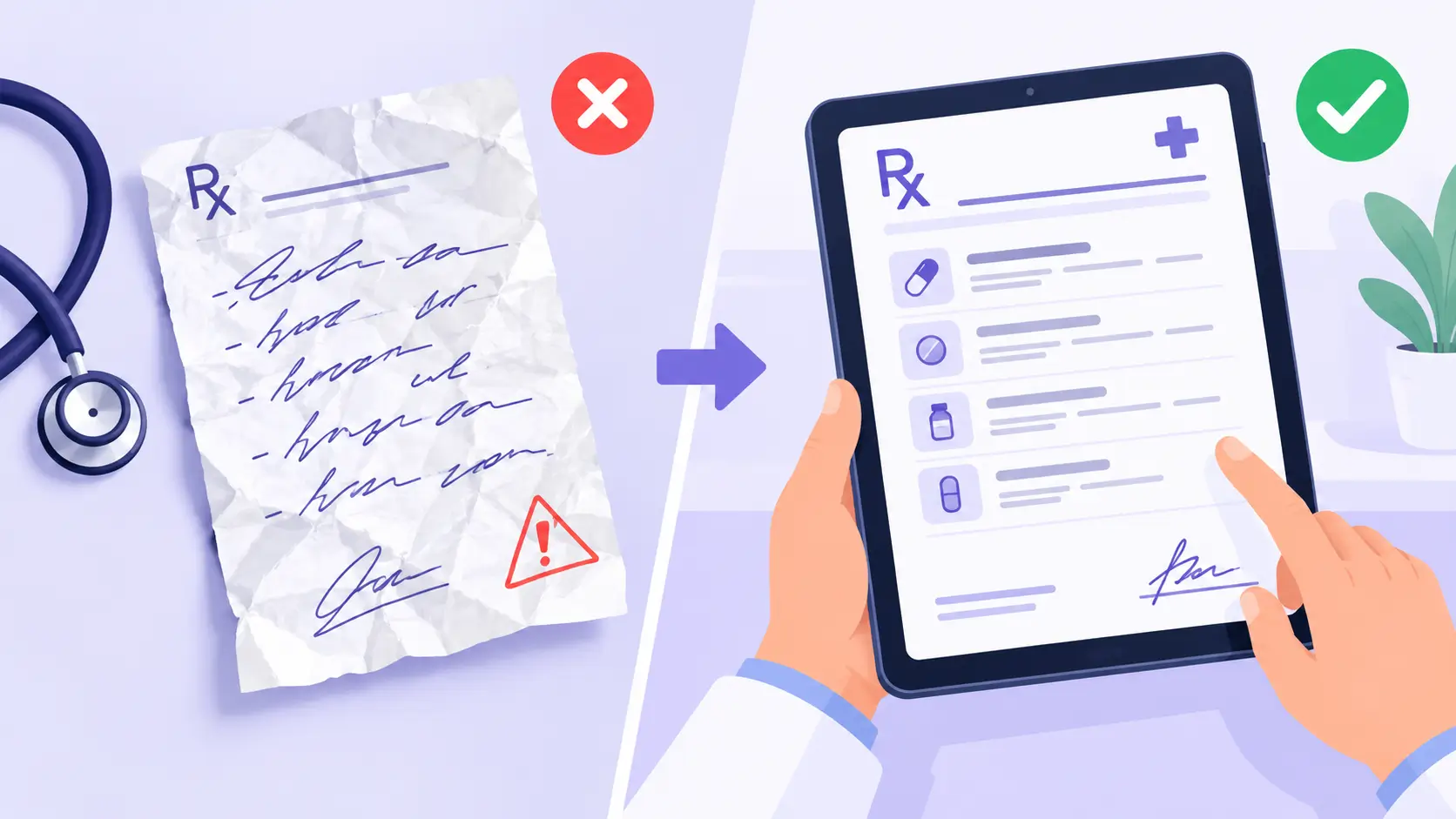
Handwritten prescriptions have served doctors for generations, but the risks are real: misread drugs, unclear doses, missed interactions, language gaps, and lost records. Digital prescriptions address each of these problems directly, while giving you a complete patient history and a more professional experience for the people who trust you.
You do not need to change how you practice. You only need to change how your decisions reach your patients.
Try Digital Prescriptions with DoctorDesk
DoctorDesk lets you write once, print a clean Bangla PDF, and share a verifiable link, with drug-interaction checks built in. Everything is saved in your patient’s record, so nothing gets lost.
Start your 14-day free trial. No card needed. Set up your workspace in a few minutes and write your first digital prescription today.